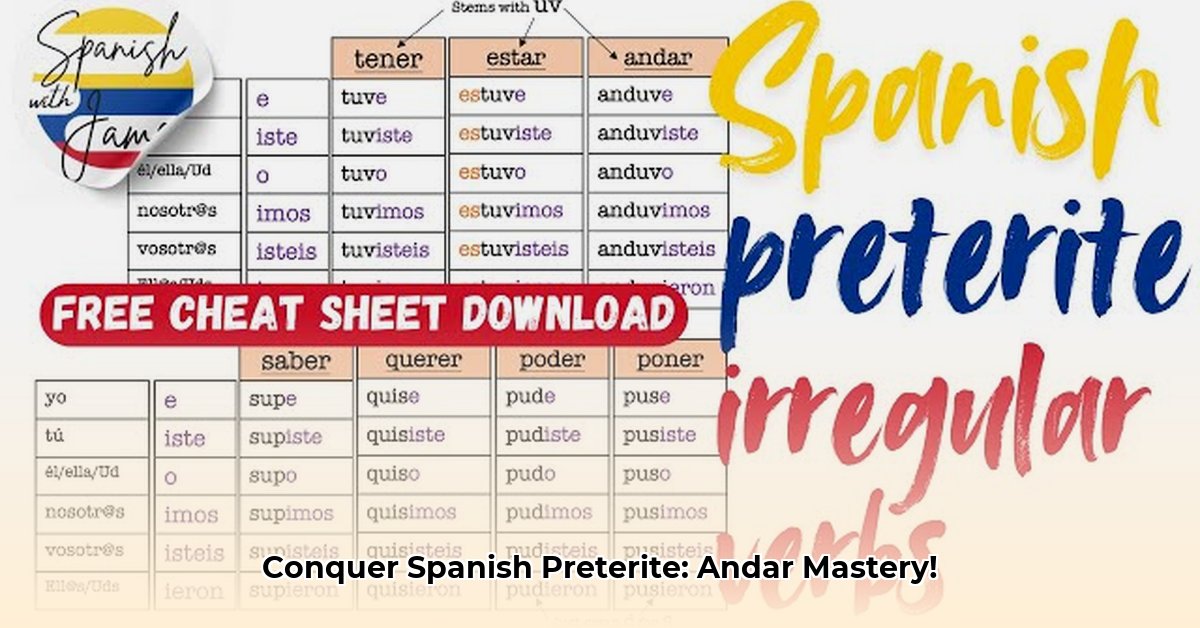
Learning the Spanish preterite tense can be challenging, but mastering irregular verbs like "andar" (to walk, to go) will significantly boost your fluency. This guide provides a clear, step-by-step approach to conjugating "andar" in the preterite, highlighting the key differences between Spain's "vosotros" and Latin America's "vos" forms. For even more practice, check out this helpful resource: Andar Preterite Conjugation. Let's get started!
Understanding the Preterite Tense
The preterite tense in Spanish describes completed actions in the past. Think of it as the equivalent of the simple past tense in English ("I walked," "She ate"). It's essential for narrating stories and describing past events clearly. Mastering the preterite will make your Spanish more precise and natural. Did you know that correctly using the preterite showcases a higher level of Spanish proficiency?
Andar: More Than Just Walking
While "andar" primarily translates to "to walk" or "to go," its usage extends to conveying general movement or even implying "to be around" or "to function". The versatility of "andar" makes it a crucial verb to master. However, its irregular conjugation in the preterite requires focused attention.
Conjugating "Andar" in the Preterite: A Comparative Guide
This table presents the preterite conjugations of "andar," comparing the "vosotros" (Spain) and "vos" (Latin America) forms. Remember, consistent practice is key to memorization.
| Pronoun | Spain ("vosotros") | Latin America ("vos") | Meaning | Example |
|---|---|---|---|---|
| yo | anduve | anduve | I walked | Yo anduve a la playa ayer. (I walked to the beach yesterday.) |
| tú | anduviste | anduviste | You (informal sing.) walked | Tú anduviste muy rápido. (You walked very fast.) |
| él/ella/usted | anduvo | anduvo | He/She/You (formal) walked | Él anduvo por el parque. (He walked through the park.) |
| nosotros | anduvimos | anduvimos | We walked | Nosotros anduvimos juntos. (We walked together.) |
| vosotros | anduvisteis | N/A | You (informal pl.) walked | Vosotros anduvisteis demasiado. (You walked too much.) |
| ellos/ellas/ustedes | anduvieron | anduvieron | They/You (formal pl.) walked | Ellos anduvieron lentamente. (They walked slowly.) |
| vos | N/A | anduviste | You (informal sing.) walked | Vos anduviste lejos. (You walked far.) |
Real-World Examples: Putting "Andar" into Practice
Here are examples illustrating "andar" in diverse sentence structures:
- Positive: Ayer, ella anduvo por el bosque. (Yesterday, she walked through the woods.)
- Negative: No anduve al mercado esta mañana. (I didn't go to the market this morning.)
- Interrogative: ¿Anduvisteis mucho hoy? (Did you all walk a lot today?)
These examples show the versatility of "andar," adapting to different sentence and contextual needs.
Practice Exercises: Solidifying Your Understanding
These exercises will help you apply your new knowledge.
Exercise 1: Fill in the blanks.
- ____ (yo) a la escuela esta mañana. (I walked to school this morning.)
- ____ (tú) al cine anoche? (Did you go to the cinema last night?)
- ____ (ellos) rápidamente. (They walked quickly.)
Exercise 2: Translate these sentences.
- We walked to the park.
- He walked the dog yesterday.
- She walked five miles.
Mastering Regional Nuances: Sounding Authentic
Remember the regional variations in "vosotros" and "vos"? Practicing both will enhance your conversational fluency and create a more natural-sounding interaction, especially when engaging with people from different Spanish-speaking regions.
Continue Your Spanish Journey!
While mastering irregular verbs like "andar" takes time and effort, consistent practice will significantly improve your Spanish skills. ¡Sigue adelante! (Keep going!) This comprehensive guide provides a robust foundation. Remember to practice regularly, and your fluency will gradually increase.